

2025 Ford E-Transit EV Maintenance Schedule
Complete Electric Van Service Intervals: Fewer Parts, Lower Costs, Less Downtime for Your Fleet
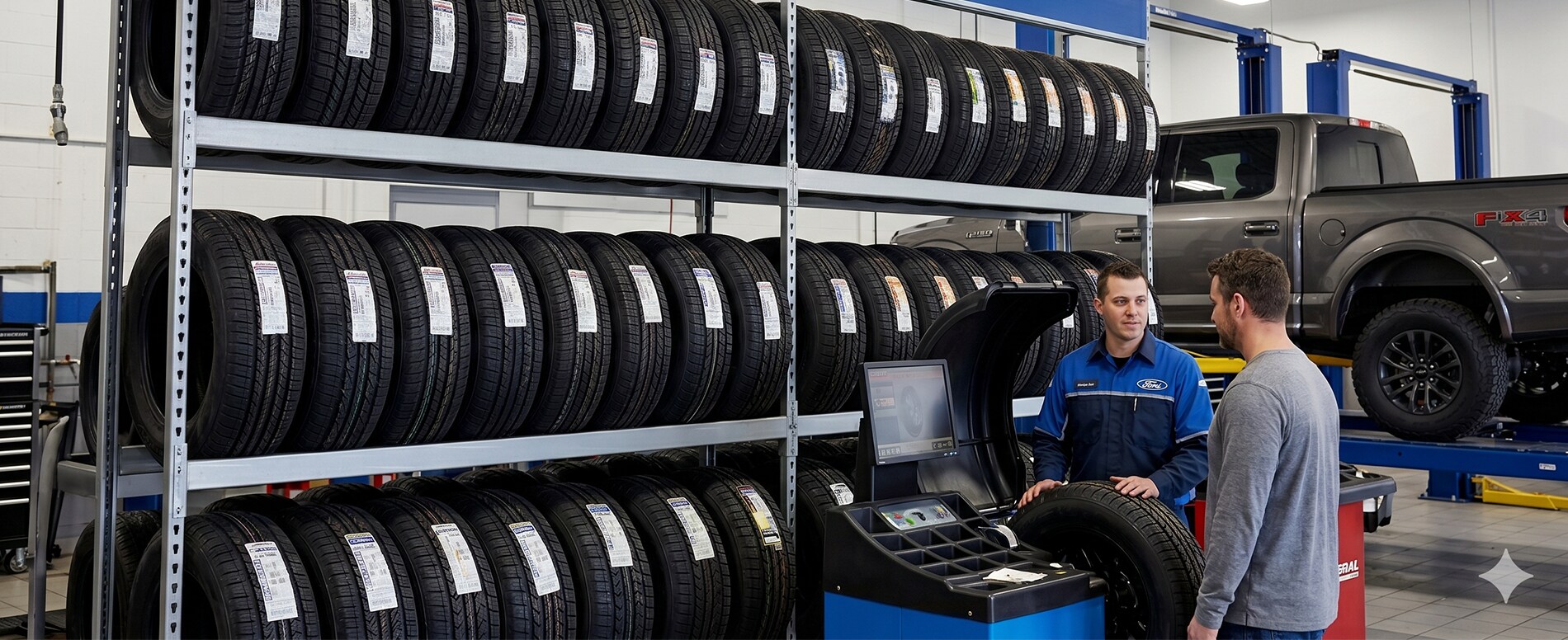
Ford E-Transit EV Maintenance Overview
The 2025 Ford E-Transit is purpose-built for commercial fleets that demand reliability and low operating costs. As a fully electric van, the E-Transit eliminates the most common and most expensive maintenance items associated with gas-powered vehicles. There are no oil changes, no spark plugs, no transmission fluid, no drive belts and no engine air filter to replace. That simplicity translates directly into reduced downtime and lower per-mile maintenance costs for fleet managers throughout Western North Carolina.
Ford's EV maintenance schedule is built around a handful of key service items: tire rotation and inspections every 12 months or 10,000 miles, cabin air filter replacement every 20,000 miles, brake fluid every 3 years, and long-interval drive-unit fluid and coolant changes. Following this schedule protects your E-Transit's 8-year/100,000-mile high-voltage battery warranty and keeps your fleet vehicles performing at peak efficiency on every delivery route and service call.
Fleet Maintenance Advantage
For fleet managers running multiple E-Transit vans, the simplified maintenance schedule means predictable service costs and easier scheduling. Without oil change intervals dictating service visits, you can consolidate maintenance around the 12-month / 10,000-mile rotation milestone, reducing the number of shop visits per vehicle per year and keeping your fleet on the road generating revenue.
Key E-Transit Service Items
Tire Rotation
Every 10,000 miles or 12 months
Includes brake inspection
Battery Coolant
Inspect every 12 months / 10,000 mi
Replace at 10 years / 200,000 mi
Brake Fluid
Every 3 years
Flush & replace
Cabin Air Filter
Every 20,000 miles
(Motorcraft FP-74)
Complete E-Transit Maintenance Schedule
The following table outlines every recommended service interval for your 2025 Ford E-Transit. Because the E-Transit has far fewer mechanical components than a gas-powered van, this schedule is streamlined, but every item on it matters for long-term reliability and battery health.
| Interval | Service Item | Details |
|---|---|---|
| Monthly | Washer Fluid & Tire Pressure | Check and top off windshield washer fluid and set tire pressures to the door-jamb label. Essential for visibility and range during Western NC mountain rain and road spray. |
| Every 6 Months | Wiper Blade Inspection | Inspect wiper blades for cracking, streaking or uneven wear. Replace annually or sooner if performance degrades. |
| Every 12 Months / 10,000 Miles | Tire Rotation & Brake Inspection | Rotate all four tires, inspect wear and measure tread depth; inspect brake pads, shoes, rotors, drums, linings, hoses and the parking brake. EVs are heavier, so tire wear is accelerated; brake wear is minimal thanks to regenerative braking. Do not exceed 1 year or 10,000 miles. |
| Every 12 Months / 10,000 Miles | Multi-Point Inspection | Inspect half-shaft boots, steering linkage, ball joints, suspension and tie-rod ends, wheels and related components, plus the charging port, high-voltage cables, 12V battery, lights and safety systems. |
| Every 12 Months / 10,000 Miles | Coolant Inspection | Check the level and strength of the Motorcraft Yellow coolant (WSS-M97B57-A2) in both loops: the high-voltage battery loop and the motor and power electronics loop. Critical for battery longevity. |
| Annually | 12V Auxiliary Battery Check | Test the 12V AGM battery (Motorcraft BAGM-48H6-760) that powers vehicle electronics, lights and door locks; replace it when it no longer passes testing. |
| Annually | Wiper Blade Replacement | Replace front wiper blades. Rear wiper (if equipped) should be replaced at the same interval. |
| Every 20,000 Miles | Cabin Air Filter | Replace the Motorcraft FP-74 cabin air filter to maintain HVAC efficiency and air quality. More frequent replacement may be needed in dusty or pollen-heavy conditions. |
| Every 3 Years | Brake Fluid | Flush and replace brake fluid regardless of mileage. Brake fluid absorbs moisture over time, reducing braking effectiveness. |
| 10 Years / 150,000 Miles | Drive Unit Fluid | Replace the electric drive assembly fluid. This is the only drivetrain fluid in the E-Transit. |
| 10 Years / 200,000 Miles | Coolant Replacement | First full replacement of the yellow coolant in the battery and motor loops (about 7.8 to 8.2 qt for the battery loop plus 9.4 to 11.3 qt for the motor and electronics loop, depending on body). Subsequent replacements every 5 years or 100,000 miles. |
| Warranty Coverage | High-Voltage Battery | Maintenance-free. Covered by Ford's 8-year/100,000-mile EV battery warranty. No scheduled service required. |
E-Transit vs Gas Transit: Maintenance Cost Comparison
One of the strongest business cases for the Ford E-Transit is the reduction in maintenance costs compared to a conventional gas-powered Transit. Fleet operators who switch to electric see savings on parts, labor and vehicle downtime. Here is how the two compare over a typical 5-year / 100,000-mile fleet ownership period:
| Maintenance Item | Gas Transit (5 yr / 100K mi) | E-Transit (5 yr / 100K mi) |
|---|---|---|
| Oil & Filter Changes | Recurring at every oil-change interval (est. $800–$1,100) | None required: $0 |
| Spark Plugs | 1 service (est. $250–$350) | None required: $0 |
| Engine Air Filter | Recurring replacements (est. $120–$200) | None required: $0 |
| Transmission Fluid | Not due until 150,000 mi | None required: $0 |
| Drive Belt | Inspected; not due for replacement until 150,000 mi | None required: $0 |
| Engine / Battery Coolant | Not due for replacement until 200,000 mi | Inspected annually; not due for replacement until 10 yr / 200,000 mi |
| Brake Pads & Rotors | 1–2 sets (est. $400–$800) | Typically 0 sets (regen braking extends life 2–3x) |
| Tire Rotation | Regular rotations (similar cost) | 10 rotations (every 12 months / 10,000 mi) |
| Cabin Air Filter | 5 replacements | 5 replacements (Motorcraft FP-74 every 20,000 mi) |
| Brake Fluid | 1 flush | 1 flush (every 3 years; same interval) |
Fleet Bottom Line
Over 5 years and 100,000 miles, the E-Transit eliminates the recurring oil changes, spark plugs and engine air filters a gas Transit needs, and regenerative braking typically saves at least one set of brake pads and rotors. That adds up to an estimated $1,500–$2,500 per vehicle in maintenance savings, or $15,000–$25,000 for a fleet of 10, plus fewer days off the road for service. The E-Transit's simplified drivetrain means fewer failure points, more predictable budgeting and reduced reliance on parts inventory. Combined with lower fuel costs (electricity vs gasoline), the total cost of ownership advantage is substantial.
Western NC Mountain Driving Considerations
Operating an E-Transit fleet in Western North Carolina introduces conditions that affect certain maintenance items more than flat-terrain driving. The mountains around Brevard, Asheville and Hendersonville demand attention to tires and brakes, even on an electric vehicle.
Mountain Routes & Your E-Transit
Routes like US-276 through the Pisgah National Forest, the Blue Ridge Parkway and I-26 through the Saluda Grade feature sustained climbs and descents that affect your E-Transit in two key ways. First, the added weight of the battery pack accelerates tire wear on steep grades, making the 12-month / 10,000-mile rotation interval critical for even wear; vans on hard mountain routes benefit from a tread check between rotations. Second, while regenerative braking handles most deceleration on long downhill stretches, actually recovering energy and extending range, the friction brakes still engage during steep descents and emergency stops. Fleet vehicles running mountain delivery routes should have brake pads inspected at every tire rotation to ensure they remain within specification.
Conditions That May Require Adjusted Intervals
- Frequent steep-grade driving (US-276, Saluda Grade)
- Heavy cargo loads at or near maximum payload
- Extreme temperatures (hot summers, freezing winters)
- Stop-and-go urban delivery routes
- Gravel or unpaved roads (Forest Service roads)
- Frequent DC fast charging in high heat
- Extended vehicle idle time with HVAC running
- Towing or hauling trailers
If your E-Transit fleet operates under any of these conditions regularly, the Mahon Ford service team can help you establish a customized maintenance schedule that accounts for the specific demands of your routes and workload.


E-Transit Owner & Fleet Manager Checks
Between scheduled service visits, these quick checks help catch issues early and keep your E-Transit running at its best. Fleet managers can incorporate these into driver pre-trip and post-trip inspection routines:
Monthly
Tire pressure • Washer fluid • All lights & signals • Charging cable condition • Tire tread depth
Every 6 Months
Wiper blades • 12V battery terminals • Charging port cleanliness • Door seals & weatherstripping • Parking brake
Annually
Coolant level & strength • 12V battery test • Tire rotation & brake inspection • Multi-point inspection • Safety warning lamps, horn & seatbelts
Before Winter
12V battery test • Tire tread depth • Wiper blades • Heater & defroster • Charging in cold weather tips
High-Voltage Battery Warranty & Care
The E-Transit's high-voltage battery pack is the heart of the vehicle, and Ford has engineered it to be maintenance-free for the life of the warranty. The battery is covered by Ford's 8-year/100,000-mile EV battery warranty, which protects against defects and capacity degradation below a specified threshold.
While the battery itself requires no scheduled maintenance, the thermal management system that keeps it at optimal operating temperature does require attention. The E-Transit uses two coolant loops, one for the high-voltage battery and one for the motor and power electronics, both filled with Motorcraft Yellow prediluted coolant. Ford calls for checking coolant level and strength at every 12-month / 10,000-mile service, with the first replacement at 10 years or 200,000 miles and every 5 years or 100,000 miles after that. Proper coolant maintenance is especially important in Western North Carolina, where summer temperatures can stress cooling systems during uphill climbs and winter cold affects charging speeds and range.
Tips for Maximizing Battery Life
- Avoid frequent DC fast charging when possible
- Keep charge level between 20% and 80% for daily use
- Park in shade during hot summer months
- Precondition the battery before departure in cold weather
- Have coolant level and strength checked at every annual service
- Address any battery warning indicators immediately
Fleet Maintenance Scheduling Made Simple
Managing maintenance for a fleet of E-Transit vans is dramatically simpler than managing a mixed or gas-powered fleet. Without oil change intervals creating staggered service windows, fleet managers can consolidate all vehicles around a single annual, mileage-based service. Here is a practical approach:
Recommended Fleet Service Strategy
Primary Service Visit (Every 12 Months or 10,000 Miles): Tire rotation and tread measurement, brake inspection, coolant level and strength check, 12V battery test, multi-point inspection including the charging system and high-voltage components, washer fluid top-off and tire pressure adjustment. For most E-Transit fleet vehicles this is the only recurring shop visit.
Milestone Services: Cabin air filter (Motorcraft FP-74) every 20,000 miles. Brake fluid flush every 3 years. Electric drive assembly fluid at 10 years or 150,000 miles. Coolant replacement at 10 years or 200,000 miles, then every 5 years or 100,000 miles.
This approach minimizes total shop visits while ensuring every service item is covered on time. Mahon Ford can work with fleet managers to schedule multiple vehicles on the same service day for maximum efficiency.
Schedule Your E-Transit Service at Mahon Ford
The Mahon Ford service center in Brevard, NC employs Ford-trained technicians certified to work on electric vehicles, including the high-voltage systems in the E-Transit. Whether your fleet needs a routine tire rotation or a milestone coolant service, our team has the specialized tools and training to keep your electric vans running reliably across Western North Carolina, from Asheville to Hendersonville, Canton to Waynesville.
Call us at (828) 884-4151 or use the links below to schedule service, visit our service center, or order genuine Ford EV parts.
Note: Maintenance intervals shown are based on Ford's scheduled maintenance guidelines for the 2025 Ford E-Transit under normal operating conditions. Actual service intervals may vary based on driving habits, cargo loads, environmental conditions and route profiles. Fleet operators should consult their owner's manual or contact Mahon Ford for guidance tailored to their specific operating conditions. Maintenance cost comparisons are estimates based on industry averages and may vary by region.
Created September 27, 2026 by MM Dealer Advocates