

2025 Ford Mustang Mach-E Maintenance Schedule
Complete EV Service Intervals: No Oil Changes, No Spark Plugs and Roughly Half the Maintenance Cost of a Gas SUV
Mustang Mach-E EV Maintenance Overview
One of the biggest advantages of owning the 2025 Ford Mustang Mach-E is dramatically lower maintenance costs compared to a traditional gas-powered SUV. With no internal combustion engine, there are no oil changes, no spark plugs, no transmission fluid, no drive belts and no engine air filter to worry about. The Mach-E's electric powertrain has far fewer moving parts than a gas engine, which means fewer things to wear out and less time spent at the service center.
That said, the Mustang Mach-E still requires regular maintenance to ensure peak performance, preserve driving range and keep you safe on Western North Carolina roads. Ford's schedule for the 2025 Mach-E is built around a single annual visit: every 12 months or 10,000 miles, whichever comes first, for tire rotation and a full round of inspections. Tires, brakes, cabin air quality and the battery thermal management system all get attention on that schedule, whether you're commuting through Brevard or tackling the elevation changes on the Blue Ridge Parkway.
Why EV Maintenance Is Different
The Mustang Mach-E uses regenerative braking to slow the vehicle and recapture energy, which means your brake pads can last two to three times longer than those on a gas SUV. However, the Mach-E's battery pack makes it heavier than comparable vehicles, so tire wear is accelerated and regular rotation is critical. The instant torque delivered by the electric motors also puts additional stress on tires. Maintaining proper tire inflation and rotation directly impacts your driving range; worn or underinflated tires can reduce range by up to 10%.
Tire Rotation
Every 10,000 miles or 12 months
(critical for range & safety)
Battery Coolant
Inspect every 12 months / 10,000 mi
Replace at 10 years / 200,000 mi
Brake Fluid
Every 3 years
(Motorcraft DOT 4 LV, regardless of mileage)
Cabin Air Filter
Every 20,000 miles
(Motorcraft FP-131)
Complete Mach-E Maintenance Schedule by Mileage & Time
| Interval | Services Performed |
|---|---|
| Monthly | Check washer fluid level • Check tire pressure (maintain the PSI on the door-jamb label for optimal range) • Inspect all exterior lights |
| Every 6 Months | Inspect wiper blades (replace annually or as needed) • Inspect charging port and cable condition • Check 12V battery terminals |
| Every 12 Months or 10,000 Miles | Rotate tires, inspect wear and measure tread depth • Multi-point inspection • Inspect brake pads, rotors, hoses and parking brake • Inspect coolant level and strength • Inspect halfshaft boots • Inspect steering linkage, ball joints, suspension and tie-rod ends • Inspect wheels for noise, wear and looseness |
| Every 20,000 Miles | Replace cabin air filter (Motorcraft FP-131); more often in dusty conditions |
| Every 3 Years | Replace brake fluid (Motorcraft DOT 4 LV, spec WSS-M6C65-A2), required regardless of mileage |
| As Needed | 12V auxiliary battery: tested at the annual inspection and replaced when it no longer passes (it powers accessories, lights and vehicle computer systems) |
| 10 Years or 150,000 Miles | Replace electric drive assembly fluid (the lubricant in the single-speed electric drive unit) |
| 10 Years or 200,000 Miles | Replace battery and motor coolant (Motorcraft Yellow prediluted, spec WSS-M97B57-A2); then every 5 years or 100,000 miles |
High-Voltage Battery Warranty
The Mustang Mach-E's high-voltage battery pack is maintenance-free under normal conditions and is covered by Ford's 8-year / 100,000-mile warranty. The battery thermal management system actively heats and cools the pack to maintain optimal temperature during charging and driving. Coolant level and strength are checked at every 12-month / 10,000-mile service, and the coolant itself is not due for replacement until 10 years or 200,000 miles.
EV vs. Gas SUV: Maintenance Cost Comparison
One of the most compelling reasons to choose the Mustang Mach-E is the long-term savings on maintenance. Without an internal combustion engine, the Mach-E eliminates many of the most expensive and frequent service items that gas SUV owners face. Here is a side-by-side comparison of estimated maintenance costs over 5 years and 60,000 miles:
| Maintenance Item | 2025 Mustang Mach-E (EV) | Comparable Gas SUV |
|---|---|---|
| Oil & Filter Changes | Not required ($0) | 6–8 changes @ $65–$85 = $390–$680 |
| Spark Plugs | Not required ($0) | 1 set @ $200–$350 = $200–$350 |
| Transmission Fluid | Not required ($0) | 1 service @ $175–$250 = $175–$250 |
| Engine Air Filter | Not required ($0) | 2 replacements @ $30–$50 = $60–$100 |
| Drive Belts | Not required ($0) | Inspection & replacement @ $150–$300 |
| Tire Rotations | 6 rotations (every 12 months / 10,000 mi) @ $25–$40 = $150–$240 | 6 rotations @ $25–$40 = $150–$240 |
| Cabin Air Filter | 3 replacements (Motorcraft FP-131 every 20,000 mi) @ $35–$50 = $105–$150 | 3 replacements @ $35–$50 = $105–$150 |
| Brake Fluid | 1 service (every 3 years) @ $100–$150 = $100–$150 | 1 service @ $100–$150 = $100–$150 |
| Brake Pads & Rotors | Minimal wear thanks to regen braking ($0–$100) | 1–2 sets @ $300–$600 = $300–$600 |
| Wiper Blades & Washer Fluid | $150–$200 | $150–$200 |
| Estimated 5-Year Total | $505–$840 | $1,780–$3,020 |
| Estimated 5-Year Savings with Mustang Mach-E: $900–$2,500 |
Beyond Maintenance: Total Fuel Savings
In addition to lower maintenance costs, the Mustang Mach-E costs significantly less to "fuel" than a gas SUV. At average Western NC electricity rates, charging the Mach-E costs roughly $0.04 per mile compared to $0.12–$0.15 per mile for a gas SUV getting 28 MPG. Over 60,000 miles, that translates to an additional $4,800–$6,600 in fuel savings on top of the maintenance savings.
Regenerative Braking & Mountain Driving
The Mustang Mach-E's regenerative braking system converts kinetic energy back into stored battery charge every time you slow down or coast. This means your friction brakes do far less work than on a conventional vehicle, and brake pads can last well over 100,000 miles. For Mach-E owners in Western North Carolina, regenerative braking provides a unique advantage on mountain roads.
When descending steep grades on routes like US-276 through the Pisgah National Forest, the Blue Ridge Parkway or the I-26 Saluda Grade, regenerative braking actually charges your battery while slowing the vehicle. Instead of wearing down brake pads on long downhill stretches, a common concern for gas vehicles in the mountains, the Mach-E recaptures that energy and adds miles of range. This is one of the most practical benefits of EV ownership in mountainous terrain.
- Regen braking captures energy on every downhill grade, extending range
- Brake pads last 2–3x longer than on gas vehicles due to reduced friction braking
- Brake pads, rotors and hoses are still inspected at every 12-month / 10,000-mile service to catch calipers seizing from disuse
- Mountain driving with elevation changes is ideal for maximizing regenerative braking
- One-pedal driving mode maximizes energy recapture on winding mountain roads
- Properly inflated tires reduce rolling resistance and preserve range on long climbs
- Cold mountain temperatures in winter can temporarily reduce range by 20–30%
- Pre-conditioning the cabin while plugged in preserves battery range in cold weather

EV Tire Care: Protecting Range & Performance
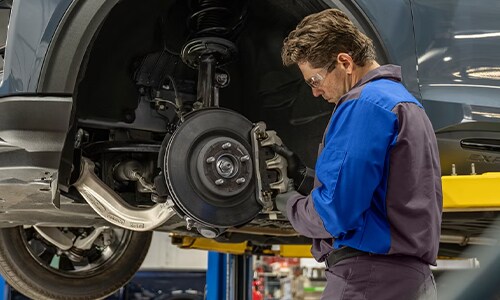
Tire maintenance is arguably the single most important service item for any electric vehicle, and the Mustang Mach-E is no exception. The Mach-E's battery pack adds considerable weight compared to a gas SUV, and the instant torque from the electric motors puts additional stress on tires during acceleration. This combination means tires wear faster on an EV if not properly maintained.
Why Tire Rotation Every 10,000 Miles Matters
Ford's schedule calls for rotating the 2025 Mach-E's tires every 12 months or 10,000 miles, whichever comes first, and inspecting wear and tread depth at the same visit. Regular rotation ensures even tread wear across all four tires, which directly impacts your driving range. Unevenly worn tires create unequal rolling resistance, forcing the Mach-E to use more energy to maintain speed. Keeping all four tires evenly worn can preserve up to 10% of your total driving range.
Many Mach-E owners also benefit from using low rolling resistance tires specifically designed for EVs. These tires are engineered to reduce the energy needed to keep the vehicle moving, further extending range without sacrificing safety. Ask the Mahon Ford tire center about EV-specific tire options for your Mach-E.
Tire Pressure and Range
Checking tire pressure monthly is one of the simplest things you can do to protect your Mach-E's range. Underinflated tires increase rolling resistance and force the battery to work harder. Ford recommends maintaining the pressure listed on the driver's door jamb label. In Western North Carolina, tire pressure can fluctuate with temperature changes, especially during fall and spring when daytime and nighttime temperatures can vary by 30 degrees or more.
Owner Maintenance Checks
Between scheduled service visits at Mahon Ford, these routine checks help you catch issues early and keep your Mach-E running efficiently. Most can be done at home in just a few minutes:
Monthly
Tire pressure • Washer fluid • All exterior lights • Charging cable condition • Wiper operation
Every 6 Months
Wiper blades • 12V battery terminals • Charging port cleanliness • Door & window seals • Parking brake
Annually
Battery coolant level • 12V battery test • Brake inspection • Tire rotation & tread depth • Multi-point inspection
Before Winter
12V battery test • Tire tread depth • Wiper blades • Washer fluid • Cabin heater • Pre-conditioning settings
Winter EV Tips for Western NC
Cold weather temporarily reduces EV range. To get the most out of your Mach-E during Western North Carolina winters, pre-condition the cabin while the vehicle is still plugged in; this warms the interior using wall power instead of battery charge. Use the FordPass app to set departure times so the battery and cabin are at optimal temperature before you unplug. The 2025 Mach-E's standard heat pump also helps warm the cabin more efficiently than resistive heat alone. Keep tires at the recommended pressure, as cold air causes PSI to drop, and consider switching to winter tires if you frequently drive mountain roads with ice and snow.
Schedule Your Mach-E EV Service at Mahon Ford
The Mahon Ford service center in Brevard, NC is equipped to handle all Mustang Mach-E maintenance and EV-specific service needs. Our Ford-trained technicians understand electric vehicle systems including high-voltage battery diagnostics, thermal management, regenerative braking calibration and electric drive unit service. We use genuine Ford and Motorcraft parts for every service.
Whether your Mach-E is due for a tire rotation, cabin air filter replacement or a comprehensive annual inspection, our team is ready to help. We serve EV owners throughout Western North Carolina including Hendersonville, Asheville, Canton, Waynesville and the surrounding Transylvania County area.
Call us at (828) 884-4151 or use the links below to book your appointment online.
Note: Maintenance intervals shown are based on Ford's scheduled maintenance guide for the 2025 Ford Mustang Mach-E under normal operating conditions. Actual service intervals may vary based on driving habits, climate, terrain and charging patterns. Cost comparisons are estimates based on average service pricing and may vary by region. The high-voltage battery is covered by Ford's 8-year/100,000-mile warranty. Always consult your owner's manual or contact Mahon Ford for guidance specific to your vehicle.
Created September 27, 2026 by MM Dealer Advocates