
Ford F-150 Lightning Maintenance Schedule
Complete EV maintenance guide for your F-150 Lightning electric truck. From Pro Power Onboard service to towing-specific maintenance, the certified technicians at Mahon Ford of Brevard keep your Lightning performing at its best on every Western NC road and trail.
Choose Your F-150 Lightning Model Year
2027 Ford F-150 Lightning
Coming soon
F-150 Lightning EV Maintenance at Mahon Ford
The 2025 Ford F-150 Lightning is a purpose-built electric work truck that eliminates dozens of traditional maintenance items. There are no oil changes, no spark plugs, no transmission fluid, no engine air filters, and no drive belts to worry about. However, the Lightning is still a full-size truck that weighs approximately 6,500 pounds, and owners who tow, haul, and use Pro Power Onboard regularly need to stay ahead of the maintenance items that do matter.
At Mahon Ford of Brevard, our Ford-certified EV technicians understand the unique demands that Western North Carolina driving places on the F-150 Lightning. Mountain grades along US-276, the Blue Ridge Parkway, and the I-26 Saluda Grade put extra stress on tires, brakes, and the battery thermal management system. Whether you use your Lightning as a daily driver, a job-site power source, or a towing machine, we provide the specialized maintenance your electric truck needs.
Key F-150 Lightning Maintenance Services
Tire Rotation
Every 7,500 miles. Critical for a 6,500-lb electric truck, especially when towing in the mountains.
Battery Coolant
Inspect annually. First replacement at 200,000 miles. Keeps the high-voltage battery at optimal temperature.
Brake Fluid
Every 3 years. Essential for hydraulic brake performance even with regenerative braking doing most of the work.
Cabin Air Filter
Every 20,000 miles. Keeps the cabin clean from pollen, dust, and debris on mountain roads.
Complete F-150 Lightning Maintenance Schedule
The table below outlines every maintenance milestone for the 2025 Ford F-150 Lightning. Unlike a gas-powered F-150 that can require 15 or more service items, the Lightning's maintenance list is streamlined but still essential for reliability, safety, and long-term performance.
| Interval | Service Item | Details |
|---|---|---|
| Monthly | Washer Fluid | Check and top off windshield washer fluid. Mountain roads and seasonal pollen buildup demand clear visibility. |
| Every 6 Months | Wiper Blade Inspection | Inspect wiper blades for cracking, streaking, or deterioration. Replace annually or sooner if performance declines. |
| 7,500 Miles | Tire Rotation & Brake Inspection | Rotate tires and inspect brake pads, rotors, and calipers. The Lightning's 6,500-lb curb weight accelerates tire wear. Towing increases this further. |
| 10,000 Miles / Annually | Multi-Point Inspection | Comprehensive inspection of suspension, steering, cooling system, charging port, and underbody components. Includes 12V auxiliary battery test. |
| Annually | Battery Coolant Inspection | Inspect high-voltage battery coolant level and condition. Critical for maintaining battery thermal management performance on mountain grades. |
| Annually | 12V Auxiliary Battery Check | Test 12V battery voltage and condition. Replace every 3-5 years. The 12V battery powers vehicle electronics, door locks, and the charging system. |
| Annually | Pro Power Onboard Inverter Test | Recommended for frequent Pro Power users. Tests inverter output at 120V and 240V to verify rated power delivery and connection integrity. |
| Annually | Wiper Blade Replacement | Replace front and rear wiper blades to maintain clear visibility during Western NC mountain rain and winter weather. |
| 20,000 Miles | Cabin Air Filter Replacement | Replace cabin air filter to maintain HVAC efficiency and air quality. Dusty job sites and gravel roads may require earlier replacement. |
| Every 3 Years | Brake Fluid Replacement | Flush and replace brake fluid regardless of mileage. Brake fluid absorbs moisture over time, reducing braking performance on steep descents. |
| 100,000 Miles | Drive Unit Fluid Replacement | Replace the electric drive unit fluid. The drive unit replaces the traditional transmission and requires far less frequent service. |
| 100,000 Mi / 5 Years | Battery Coolant System Service | Full inspection of battery coolant system including hoses, connections, and coolant condition. First full coolant replacement at 200,000 miles. |
| 200,000 Miles | Battery Coolant Replacement | First complete battery coolant flush and replacement. Ensures long-term thermal management performance for the high-voltage battery pack. |
High-Voltage Battery Warranty: The 2025 F-150 Lightning's high-voltage battery is maintenance-free and covered by Ford's 8-year/100,000-mile warranty. Extended range battery models receive an 8-year/150,000-mile warranty. No routine battery maintenance is required by the owner, though annual inspections at Mahon Ford help identify any issues early.
F-150 Lightning vs. Gas F-150: Maintenance Comparison
One of the most significant advantages of owning a 2025 Ford F-150 Lightning is the reduction in routine maintenance compared to a gasoline-powered F-150. The Lightning eliminates an entire category of engine-related service items, which translates directly into lower annual costs and fewer trips to the shop.
| Maintenance Item | 2025 F-150 Lightning (EV) | 2025 F-150 (Gas V6/V8) |
|---|---|---|
| Oil Changes | Not Required — No engine | Every 7,500-10,000 miles (~$70-$100 each) |
| Spark Plugs | Not Required — No combustion | Every 60,000-100,000 miles (~$200-$400) |
| Transmission Fluid | Not Required — No transmission | Every 30,000-60,000 miles (~$150-$250) |
| Engine Air Filter | Not Required — No engine | Every 15,000-30,000 miles (~$25-$50) |
| Drive Belts | Not Required — No belts | Every 60,000-100,000 miles (~$100-$200) |
| Tire Rotation | Every 7,500 miles (~$50-$80) | Every 7,500-10,000 miles (~$50-$80) |
| Brake Pads | 100,000+ miles (regen braking) (~$200-$350) | Every 30,000-50,000 miles (~$200-$350 each time) |
| Brake Fluid | Every 3 years (~$80-$120) | Every 2-3 years (~$80-$120) |
| Cabin Air Filter | Every 20,000 miles (~$30-$60) | Every 15,000-20,000 miles (~$30-$60) |
| Coolant | Battery coolant: inspect annually (~$50-$80) | Engine coolant: every 30,000 miles (~$100-$150) |
| Estimated Annual Cost | $400 - $600 | $900 - $1,200 |
| 5-Year Maintenance Savings | Lightning owners save approximately $2,500 - $3,000 over 5 years | |
These savings are in addition to lower fuel costs. Charging a Lightning at home costs roughly the equivalent of $1.20 per gallon compared to gasoline prices in Western North Carolina. Over 5 years of ownership, total cost of operation savings can exceed $10,000 when combining reduced maintenance and fuel costs.
Pro Power Onboard Maintenance
Keeping Your Built-In Generator Ready for Work
The 2025 F-150 Lightning's Pro Power Onboard system transforms your truck into a mobile power source capable of delivering up to 9.6 kW of electricity through 120V and 240V outlets. Whether you are running power tools on a job site, powering a campsite, or providing backup electricity during a storm, the Pro Power system is one of the Lightning's most valuable features. Maintaining it properly ensures it delivers rated output when you need it most.
Annual Inverter Output Test: Ford recommends that frequent Pro Power Onboard users schedule an annual inverter output test. This diagnostic verifies that the inverter is converting DC battery power to AC output at the correct voltage, frequency, and wattage. The certified technicians at Mahon Ford of Brevard can perform this test as part of your annual multi-point inspection.
Impact on Battery and Cooling System: Sustained Pro Power Onboard use generates additional heat within the battery pack, increasing demand on the thermal management system. If you regularly use Pro Power for extended periods, especially during hot summer months in Western NC, have your battery coolant inspected more frequently. We recommend a coolant level and condition check every 6 months for heavy Pro Power users.
Outlet and Connection Inspection: The 240V outlet in the truck bed and the cabin 120V outlets should be visually inspected for corrosion, debris, or damage during each service visit. Job-site environments can introduce dust, moisture, and physical wear to these connections.
How Towing Affects F-150 Lightning Maintenance
Lightning owners in Western North Carolina often use their trucks for towing boats, trailers, campers, and equipment. Towing increases the maintenance demands on several key systems, and understanding these impacts helps you plan service visits accordingly.
Tire Wear and Rotation
The F-150 Lightning's curb weight of approximately 6,500 lbs already puts more stress on tires than a comparable gas F-150. Adding a trailer compounds this effect significantly. Towing on mountain roads with switchbacks and elevation changes, like the routes along US-276 between Brevard and the Blue Ridge Parkway, accelerates shoulder wear and reduces tread life. If you tow regularly, consider rotating your tires every 5,000 miles instead of the standard 7,500-mile interval.
Brake System Demand
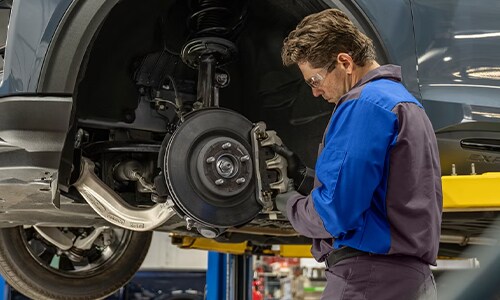
While regenerative braking handles much of the deceleration during normal driving, towing on steep descents such as the I-26 Saluda Grade requires more engagement from the conventional friction brakes. Heavier loads mean higher brake temperatures and faster pad wear. We recommend a thorough brake inspection at every tire rotation for Lightning owners who tow, with particular attention to rotor thickness and pad depth.
Battery Cooling System Stress
Towing draws more energy from the battery pack, which generates additional heat. Climbing mountain grades with a loaded trailer pushes the thermal management system harder than normal highway driving. This increased thermal load makes annual battery coolant inspections even more important. For owners who tow frequently through the mountains between Brevard, Canton, and Asheville, we recommend a battery coolant check every 6 months.
Suspension and Steering
Towing places additional stress on suspension components, ball joints, tie rod ends, and wheel bearings. The added tongue weight and dynamic forces during mountain driving accelerate wear on these components. Our multi-point inspection includes a thorough assessment of all suspension and steering components, and we recommend this inspection at least annually for owners who tow.
- Towing on mountain grades increases tire wear by 20-30%
- Heavy trailer loads require more frequent brake inspections
- Sustained uphill towing stresses the battery cooling system
- Tongue weight affects front-end alignment and tire wear patterns
- Gravel roads and job sites increase cabin air filter contamination
- Frequent Pro Power use while towing doubles cooling system demand
- Winter towing on salted roads accelerates undercarriage corrosion
- Steep descents on US-276 and I-26 increase conventional brake use
F-150 Lightning Owner Maintenance Checklist
Between service visits, Lightning owners can stay ahead of maintenance needs with these simple checks. A few minutes of attention each month can prevent costly repairs and keep your electric truck running at peak performance.
Monthly Checks
Top off washer fluid. Check tire pressure (recommended 35 PSI). Inspect charging cable and port for damage. Verify all exterior lights function.
Every 6 Months
Inspect wiper blades for wear. Check cabin air filter condition. Test all Pro Power Onboard outlets. Inspect undercarriage for damage or corrosion.
Annually
Schedule multi-point inspection. Replace wiper blades. Have 12V battery tested. Request battery coolant inspection and Pro Power Onboard inverter test.
Before Winter
Check tire tread depth and consider winter tires for mountain driving. Verify battery preconditioning works. Inspect defroster and heated seats. Top off washer fluid with winter formula.
Mountain Driving and Your Lightning
Western North Carolina's terrain presents unique conditions for F-150 Lightning owners. The combination of steep grades, elevation changes, and variable weather affects several maintenance-related systems on your electric truck.
Driving the I-26 Saluda Grade, one of the steepest interstate grades on the East Coast, demonstrates both the advantages and demands of EV ownership. Descending, the Lightning's regenerative braking recaptures energy and saves your brake pads. Ascending with a loaded trailer, the battery thermal management system works overtime to keep pack temperatures in the optimal range. These conditions make annual battery coolant inspections at Mahon Ford of Brevard a priority rather than a suggestion.
Mountain curves and uneven road surfaces along the Blue Ridge Parkway and US-276 between Brevard and Canton also affect tire wear patterns differently than flat highway driving. We often see increased inside-edge wear on Lightning tires due to the combination of vehicle weight and lateral forces during mountain cornering. Regular tire rotations every 7,500 miles help distribute this wear evenly and extend tire life.
Winter Driving Tip: Cold temperatures temporarily reduce the Lightning's driving range by 20-30%. Precondition your battery while plugged in before departing to maximize range and reduce thermal stress on the battery pack. The Lightning's preconditioning system warms the battery to optimal operating temperature, which also improves regenerative braking effectiveness on cold mountain mornings.
Schedule Your Lightning Service Today
Mahon Ford of Brevard is your trusted source for 2025 Ford F-150 Lightning maintenance and service near Canton, NC. Our Ford-certified EV technicians have the training, equipment, and diagnostic tools to service every system on your Lightning, from tire rotations to high-voltage battery coolant inspections and Pro Power Onboard diagnostics.
Maintenance intervals and cost estimates are based on Ford Motor Company recommendations for the 2025 F-150 Lightning under normal driving conditions. Actual service intervals may vary based on driving habits, towing frequency, terrain, climate, and vehicle usage. Mountain driving, frequent towing, and heavy Pro Power Onboard use may require more frequent service. Contact Mahon Ford of Brevard at (828) 884-4151 for a personalized maintenance plan tailored to your driving conditions. Prices shown are estimates and may vary. Mahon Ford of Brevard, 1235 Asheville Hwy, Brevard, NC 28712.
Created September 29, 2026 by MM Dealer Advocates